- Philip AG et al..(1969)
Placental transfusion as an
intrauterine phenomenon in
deliveries complicated by
foetal distress. - Redmond A et al. (1965)
Relation of onset of
respiration to placental
transfusion.
- Philip AG, Yee AB, Rosy M, Surti N, Tsamtsouris A, Ingall D. Placental
transfusion as an intrauterine phenomenon in deliveries complicated by
foetal distress. Br Med J. 1969 Apr 5;2(5648):11-3. - Redmond A, Isana S, Ingall D. Relation of onset of respiration to placental
transfusion. Lancet. 1965 Feb 6;1:283-5.
Prenatal transfer of blood from placenta to lungs
Philip et al. (1969) reported placental transfusion in
infants who suffered distress during delivery [1].
Data for this paper are from the same Boston City
Hospital Unit where Redmond et al. (1965) worked
[2], and the authors described the background for
their research as follows:
Measurement of residual placental blood was an
ongoing part of research at this site, thus the
comparison control group were 20 infants born just
prior and just subsequent to the 10 infants with
evidence of foetal distress based on changes in
heart rate and/or meconium staining of the amniotic
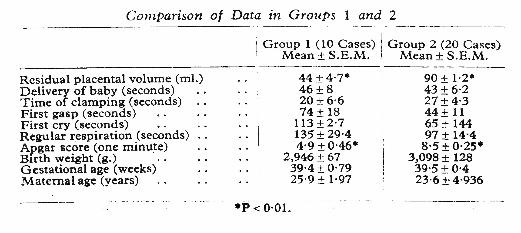
fluid. The infants with difficult births had lower 1-
minute Apgar scores (mean 4.9) that the comparison
group (mean 8.5), but their neonatal course was
described as uneventful. The table of statistics
gathered is reproduced below.
From their opening remarks, it can be inferred that
Philip et al. regarded postnatal transfusion as
potentially harmful:
The contrast in opinion with that of most earlier
researchers is striking. "Delayed clamping" was
beginning to be viewed as perhaps a blunder to be
avoided.
Philip et al. (1969) reported placental transfusion in
infants who suffered distress during delivery [1].
Data for this paper are from the same Boston City
Hospital Unit where Redmond et al. (1965) worked
[2], and the authors described the background for
their research as follows:
- "During the course of our continuing studies on
placental transfusions we accumulated data on
200 newborn infants whose cords were ligated
within seconds of delivery of the chin and before
the onset of respiration (thus qualifying them for
anybody's definition of early clamping). Ten of
these infants were noted on analysis to have
residual placental volumes that were much lower
than expected. The purpose of this
communication is to report our observations on
these infants and to contrast them with infants
who were also " early clamped " but whose
residual placental volumes fell in the expected
range.
...The infants forming the basis of this report
were delivered at the Boston City Hospital. In all
instances the cord was clamped less than 60
seconds after delivery of the chin and more than
10 seconds before the first breath." [1, p12]
Measurement of residual placental blood was an
ongoing part of research at this site, thus the
comparison control group were 20 infants born just
prior and just subsequent to the 10 infants with
evidence of foetal distress based on changes in
heart rate and/or meconium staining of the amniotic
fluid. The infants with difficult births had lower 1-
minute Apgar scores (mean 4.9) that the comparison
group (mean 8.5), but their neonatal course was
described as uneventful. The table of statistics
gathered is reproduced below.
From their opening remarks, it can be inferred that
Philip et al. regarded postnatal transfusion as
potentially harmful:
- "The resurgence of interest in the potential
pathological effects of a postnatal placental
transfusion has rekindled interest in the
physiology of this phenomenon in man." [1, p11]
The contrast in opinion with that of most earlier
researchers is striking. "Delayed clamping" was
beginning to be viewed as perhaps a blunder to be
avoided.
Data on babies who suffered distress during delivery (group 1) compared with
babies with uncomplicated deliveries (group 2). From Philip et al. (1969)
babies with uncomplicated deliveries (group 2). From Philip et al. (1969)