- Bound JP, Harvey PW, Bagshaw HB. Prevention of pulmonary syndrome of
the newborn. Lancet. 1962 Jun 9;1:1200-3. - Secher O, Karlberg P. Placental blood-transfusion: For Newborns
delivered by Cæsarean Section. Lancet 1962 Jun 9; 279(7241):1203-1205. - Anonymous (editorial). Placental Transfusion. Lancet 1962 Jun 9; 279
(7241):1222-1223. - Karlberg P. The adaptive changes in the immediate postnatal period, with
particular reference to respiration. J Pediatr. 1960 May;56:585-604. - Landau DB, Goodrich HB, Francka WF, Burns FR (1950) Death of
cesarean infants: a theory as to its cause and a method of prevention.
Journal of Pediatrics 36:421-426. - Haselhorst G. Uber Art und Dauer der Blutstromung in den
Nabelschnurgefassen post partum. Z Geburtshilfe Gynakol 1929; 96:487-
499 - Allmeling A. Die Gewichtszunahme von Neugeborenen infolge postnataler
Transfusion. Zentralbl Gynakol 1930; 54:850-860. - DeMarsh QB, Windle WF, Alt HL (1942) Blood volume of newborn infant in
relation to early and late clamping of umbilical cord. Am J Dis Child 63:
1123-1129. - Ballentine GN. Delayed ligation of the umbilical cord. The Pennsylvania
Medical Journal 1947,Apr;50 (7):726-728. - Hormann G, Lemtis I (1954) Untersuchungen uber den fetalen
Plazentakreislauf warhrend der Nachgeburtsperiode. Zentralblatt fur
Gynakologie 76(9):329-341. - Gunther M (1957) The transfer of blood between baby and placenta in the
minutes after birth. Lancet. 1957 Jun 22;272(6982):1277-80.
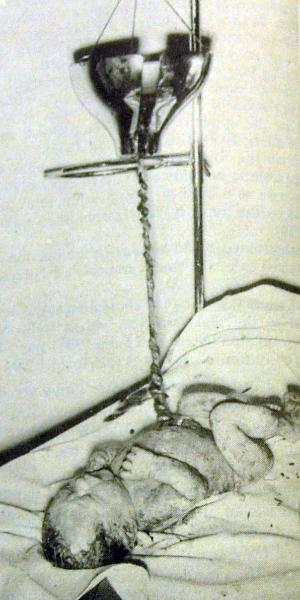
Infant attached to placenta in the
funnel. The umbilical cord hangs
freely from funnel to infant.
From Secher et al. (1962), p1204)
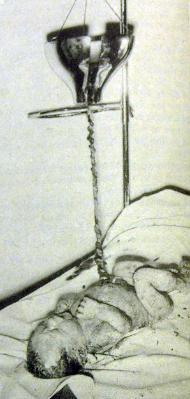
funnel. The umbilical cord hangs
freely from funnel to infant.
From Secher et al. (1962), p1204)
Concerns over umbilical cord clamping
As in the 1940s and 1950s, concerns continued to
be raised by some over the safety of clamping the
cord. Recognition of increasing numbers of newborn
infants developing respiratory distress syndrome, as
possibly related to not waiting even for the first
breath before clamping the cord, motivated more
research to investigate consequences of early
versus "late" clamping. Application of the clamp
early was clearly so widespread by this time, that
apparently no ethical problem was perceived in
randomly assigning infants to early or late clamping
groups for research, even when the question was
whether early clamping might not be safe.
Two important articles appeared in the Lancet for
June 9, 1962 along with an equally thoughtful
editorial [1-3].
Bound et al. (1962) investigated pulmonary
syndrome in two groups of infants. In the first group,
born between January 1957 through May 1959, the
cord was usually ligated immediately after birth,
except in cases in which mucus first had to be
aspirated from the pharynx. Delay in use of the
clamp in these cases indicates instinctive good
judgement was still exercised, based on individual
circumstances. Infants born between June 1959
through June 1961 comprised the second group,
when three to five minutes after delivery elapsed
before applying the clamp. The number of cases of
pulmonary syndrome was found to be significantly
less in the second period, and the reduction was
most significant in low birth-weight infants (1501-
2000 g).
Bound et al attributed the improved outcome to the
delayed ligation of the cord during the second period:
cord should become a standard procedure at the
delivery of all premature babies.
Secher and Karlberg (1962) reviewed understanding
of mechanisms involved in transition from
intrauterine to extra-uterine circulation and
respiration [2]. Karlberg's (1960) investigations and
ideas about transfer of respiration from placenta to
lungs were extensive and remain relevant to this still
poorly understood phenomenon [4].
Secher and Karlberg, like Landau et al. (1950),
recognized that the usual technique for caesarean
section was un- physiological, and when performed
in an emergency situation often left the infant in a
state of circulatiory insufficiency and shock. They
adopted a method similar to that of Landau et al.
(1950) providing postnatal placental transfusion to
infants born by emergency Cesarean section by
removing the placenta with the baby without cutting
the cord and placing the placenta in a funnel hung
above the baby (see picture below). For
comparison, they did the same with vaginally
delivered babies, using a temporary clamp on the
cord until the placenta was delivered.
Secher and Karlberg cited several earlier
investigations of placental transfusion [6-11], and
concurred with Landau et al. (1950) by commenting:
Thus, though use of a clamp on the umbilical cord
was in widespread use by the early 1960s, there
were still proponents of the traditional method of
waiting for, and promoting, placental transfusion
after birth.
As in the 1940s and 1950s, concerns continued to
be raised by some over the safety of clamping the
cord. Recognition of increasing numbers of newborn
infants developing respiratory distress syndrome, as
possibly related to not waiting even for the first
breath before clamping the cord, motivated more
research to investigate consequences of early
versus "late" clamping. Application of the clamp
early was clearly so widespread by this time, that
apparently no ethical problem was perceived in
randomly assigning infants to early or late clamping
groups for research, even when the question was
whether early clamping might not be safe.
Two important articles appeared in the Lancet for
June 9, 1962 along with an equally thoughtful
editorial [1-3].
Bound et al. (1962) investigated pulmonary
syndrome in two groups of infants. In the first group,
born between January 1957 through May 1959, the
cord was usually ligated immediately after birth,
except in cases in which mucus first had to be
aspirated from the pharynx. Delay in use of the
clamp in these cases indicates instinctive good
judgement was still exercised, based on individual
circumstances. Infants born between June 1959
through June 1961 comprised the second group,
when three to five minutes after delivery elapsed
before applying the clamp. The number of cases of
pulmonary syndrome was found to be significantly
less in the second period, and the reduction was
most significant in low birth-weight infants (1501-
2000 g).
Bound et al attributed the improved outcome to the
delayed ligation of the cord during the second period:
- "The results of this investigation indicate, within
the limitations of a consecutive trial, that receipt
of an adequate amount of placental blood is an
important factor in the prevention of the
pulmonary syndrome in premature babies." [1,
p1202]
cord should become a standard procedure at the
delivery of all premature babies.
Secher and Karlberg (1962) reviewed understanding
of mechanisms involved in transition from
intrauterine to extra-uterine circulation and
respiration [2]. Karlberg's (1960) investigations and
ideas about transfer of respiration from placenta to
lungs were extensive and remain relevant to this still
poorly understood phenomenon [4].
Secher and Karlberg, like Landau et al. (1950),
recognized that the usual technique for caesarean
section was un- physiological, and when performed
in an emergency situation often left the infant in a
state of circulatiory insufficiency and shock. They
adopted a method similar to that of Landau et al.
(1950) providing postnatal placental transfusion to
infants born by emergency Cesarean section by
removing the placenta with the baby without cutting
the cord and placing the placenta in a funnel hung
above the baby (see picture below). For
comparison, they did the same with vaginally
delivered babies, using a temporary clamp on the
cord until the placenta was delivered.
Secher and Karlberg cited several earlier
investigations of placental transfusion [6-11], and
concurred with Landau et al. (1950) by commenting:
- "Late clamping of the cord has been an
accepted rule in normal deliveries, and its
importance was pointed out by Erasmus Darwin
as early as 1801." [2, p1203]
Thus, though use of a clamp on the umbilical cord
was in widespread use by the early 1960s, there
were still proponents of the traditional method of
waiting for, and promoting, placental transfusion
after birth.
- Bound JP et al. (1962)
Prevention of pulmonary
syndrome of the newborn. - Secher O, Karlberg P (1962)
Placental blood-transfusion:
For Newborns delivered by
Cæsarean Section. - Anonymous (Lancet
editorial). Placental
Transfusion. - Karlberg P (1960) The
adaptive changes in the
immediate postnatal period,
with particular reference to
respiration. - Landau DB et al. (1950)
Death of cesarean infants: a
theory as to its cause and a
method of prevention. - Haselhorst G (1929) Uber
Art und Dauer der
Blutstromung in den
Nabelschnurgefassen post
partum. - Allmeling A (1930) Die
Gewichtszunahme von
Neugeborenen infolge
postnataler Transfusion. - DeMarsh QB et al. (1942)
Blood volume of newborn
infant in relation to early and
late clamping of umbilical
cord. - Ballentine GN (1947).
Delayed ligation of the
umbilical cord. - Hormann G, Lemtis I (1954)
Untersuchungen uber den
fetalen Plazentakreislauf
warhrend der
Nachgeburtsperiode. - Gunther M (1957) The
transfer of blood between
baby and placenta in the
minutes after birth.