The error entrenched
Hidvegi and Hesseltine (1966) proudly celebrated
use of the Hesseltine clamp for nearly three decades:
remains a thriving business, though umbilical clamps
are not advertised on their website:
http://www.americancoil.com/
Hesseltine (1937) introduced this clamp with the
following remarks:
Instructions on time of clamping were not given as
they were by Wechsler (1912) or Dicks (1925), who
both stated that the clamp should be applied after
pulsations in the cord had ceased [3, 4].
It seems clear though that by the 1930s collection of
umbilcal cord blood to be stored for transfusions had
become popular. Therefore, Hesseltine's remarks
about the pressures the clamp should withstand
make it apparent that this and other clamps were
already applied before pulsations in the cord had
ceased:
Introduction of more clamps
Payton (1960) introduced yet another clamp, a nylon
disposable clamp with a snap to prevent its
reopening once clamped shut:
Thus permanent clamping during the third stage of
labor was apparently common by the 1960s.
Mayer (1964) described a clamp combined with
scissors, introducing it as follows:
waiting for pulsations of the cord to cease, seems to
have been completely forgotten about by the mid
1960s.
Hidvegi and Hesseltine (1966) proudly celebrated
use of the Hesseltine clamp for nearly three decades:
- "In May, 1937, a report was given of a simple
and safe umbilical cord clamp. Directions were
advanced for its use and documentations of it
reliability and safety were stated...
...It has been used routinely at this institution on
some 90,000 newborns since July 1, 1937.
...Improvement has been made recently by the
placement of serrations on the proximating
surfaces of both arms.. These imprints provide
added resistance to slippage if the cord is
unintentionally severed adjacent to the clamp.
...The device as designed will withstand
pressure up to 200 mm mercury." [1, p567]
"The manufacturer (The American Coil Spring
Company) reports the six millionth (6,000,000)
clamp was produced on July 15 1965...
Obviously, then, a minimum of six million babies
have been treated by the clamp... each clamp
has been used an average of five times at a
minimum. On this assumption, six million clamps
represent a usage upon, at least, 30 million
newborn infants.
...This one unit instrument is uncomplicated in
application, reusable inumerable times and
economical in service... Another advantage is
that if the instrument is unsatisfactorily located,
it can be easily removed and confidently re-
applied." [1, p568]
remains a thriving business, though umbilical clamps
are not advertised on their website:
http://www.americancoil.com/
Hesseltine (1937) introduced this clamp with the
following remarks:
- "Many types of instruments and appliances
have been devised and used to replace ligation
in the care of the umbilical cord of the newly
born infant. Ligation is still the most commonly
used but it popularity is obviously waning. Any
successful method must provide complete
asepsis, proper hemostasis, and normal wound
healing." [2, p884]
Instructions on time of clamping were not given as
they were by Wechsler (1912) or Dicks (1925), who
both stated that the clamp should be applied after
pulsations in the cord had ceased [3, 4].
It seems clear though that by the 1930s collection of
umbilcal cord blood to be stored for transfusions had
become popular. Therefore, Hesseltine's remarks
about the pressures the clamp should withstand
make it apparent that this and other clamps were
already applied before pulsations in the cord had
ceased:
- "Since Nov. 15, 1935, to the present time over
1,500 unselected babies have had their cords
treated by this method. Since the systolic blood
pressure of newly born infants probably does
not exceed 100mm mercury and these clamps
prevent vascular leaks with pressures in excess
of 250 mm. mercury and do not slip, there
should be no bleeding. This contention is
verified by complete hemostasis in all
applications." [2, p885]
Introduction of more clamps
Payton (1960) introduced yet another clamp, a nylon
disposable clamp with a snap to prevent its
reopening once clamped shut:
- "Ideally, the obstetrician and pediatrician have
several aims in mind when severing and
occluding an umbilical cord during the third
stage of labor. The primary aim is complete
hemostasis of any sized cord, preferably
obtained without cutting into the jelly of
Wharton." [5, p1024]
Thus permanent clamping during the third stage of
labor was apparently common by the 1960s.
Mayer (1964) described a clamp combined with
scissors, introducing it as follows:
- "It is present obstetric practice at all deliveries,
whether vaginal (with or without forceps) or
caesarean section, to clamp the umbilical cord
in two places and cut between them with a pair
of scissors. The clamps usually used are pairs
of Spencer Wells forceps or the new type
disposable plastic clamps.
Such a series of actions is necessarily time
consuming at the very moment when valuable
seconds could be spent in infant resuscitation
or maternal haemostasis." [6, p1692]
waiting for pulsations of the cord to cease, seems to
have been completely forgotten about by the mid
1960s.
- Hidvegi IG, Hesseltine HC
(1966) The Hesseltine cord
clamp. - Hesseletine HC (1937) A
simple, safe and
economical cord clamp. - Wechsler BB (1912)
Umbilical clamp. - Dicks JF (1925) Treatment of
the umbilical cord by short
ligation and the use of a
clamp. - Payton HW (1960) A nylon
disposable umbilical cord
clamp. - Mayer TC. Combined
umbilical scissors and cord
clamp.
- Hidvegi IG, Hesseltine HC. The Hesseltine cord clamp. Northwest Med.
1966 Jul;65(7):567-8. - Hesseletine HC. A simple, safe and economical cord clamp. Am J Obst
Gynecol. 1937 May; 33:884-5. - Wechsler BB. Umbilical clamp. Am J Obstet Dis Women Child 1912; 60:85-
6. - Dicks JF. Treatment of the umbilical cord by short ligation and the use of a
clamp. Am J Obstet Gynecol 1925 Nov; 10(5):706-8. - Payton HW. A nylon disposable umbilical cord clamp. Am J Obstet Gynecol.
1960 May;79:1024-5. - Mayer TC. Combined umbilical scissors and cord clamp. Br Med J. 1964
Jun 27;1(5399):1692. Online at: http://www.pubmedcentral.nih.
gov/articlerender.fcgi?tool=pubmed&pubmedid=14147753
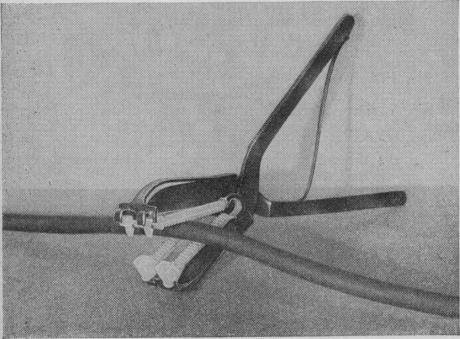
Combined Umbilical Scissors and Cord Clamp. From Mayer (1964)
Combined Umbilical Scissors
and Cord Clamp.
From Mayer (1964)
and Cord Clamp.
From Mayer (1964)